
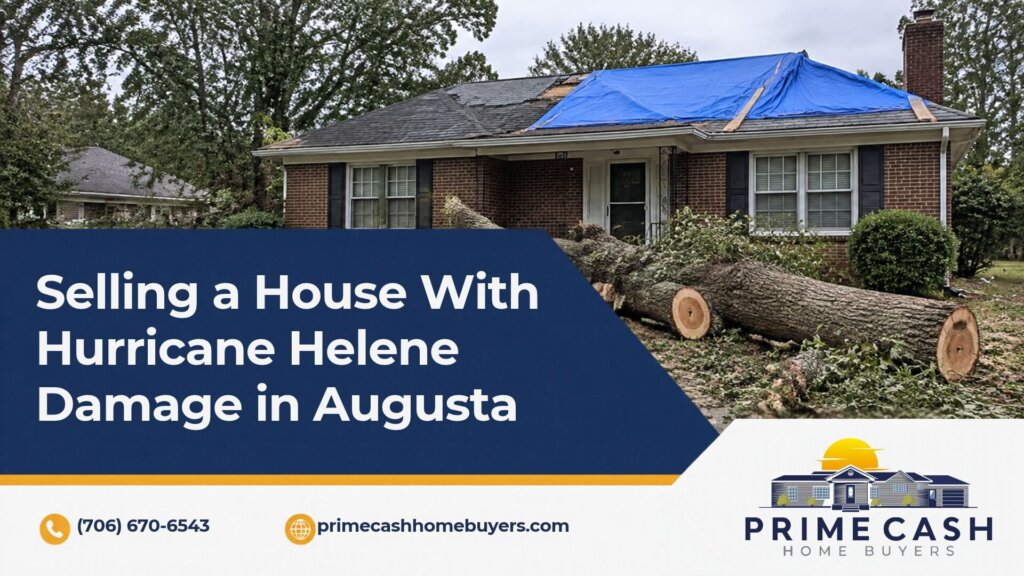
Yes, you can sell a house that still has Hurricane Helene damage, even with a tarp on the roof, an open insurance claim, or a contractor who never came back. Two years after the storm hit the Augusta area on September 27, 2024, plenty of homeowners in Richmond County, Martinez, Evans and Hephzibah are still living with a half-finished recovery. If that’s you, you’re not stuck. You have a few real options, and each one trades time, money and hassle differently.
The National Weather Service office in Columbia estimated peak gusts of 80 to 100+ mph in Richmond and Columbia counties, with widespread trees and power lines down. So many of the houses still waiting on repairs share a story: a tree came through the roof, rain followed, and then a slow fight with insurers and contractors.
I’m Chris Krausnick, the owner of Prime Cash Home Buyers here in Augusta. I’m a real estate investor, not a licensed real estate agent, and I buy houses as-is for cash. This post is part of our guide on how to sell an old house in Augusta, GA, because storm damage on an older home tends to uncover everything else that was already tired.
You can sell a house with unrepaired storm damage. Here’s how
You have three basic paths: finish the repairs and list, list as-is with an agent, or sell as-is to a cash buyer. None of them requires the house to be perfect first.
Repairing first usually brings the highest price, if you have the cash, contractor and patience. Listing as-is with an agent can work when the damage is limited, though you’ll mostly draw investors and renovation buyers. A cash sale is the fastest and most certain path, but the offer will be lower than a retail price on a repaired house. That’s the honest trade-off.
If your house sits near one of Augusta’s creeks and the storm brought water in, read our companion post on selling a house in an Augusta flood zone, since flood history adds its own questions.
Open insurance claims: who gets the payout when you sell
Who gets the payout depends on your policy, your mortgage and your purchase contract, so it has to be settled in writing before closing.
If you have a mortgage, your claim check may be made out to both you and your lender. The federal bank regulators’ consumer site, HelpWithMyBank.gov, notes that the check may be payable to both the policy holder and the lien holder, and that you should contact your lender to find out the next steps. If you sell before repairs happen, the loan gets paid off at closing, and what happens to any held funds is between you, the servicer and the contract.
When you sell with a claim still open, there are a few common ways to handle it:
- You keep the claim and any future payments, and the buyer prices the house as-is.
- You assign the claim proceeds to the buyer, and the price reflects that.
- You settle or close out the claim before closing so everyone knows the number.
Put whichever one you choose in writing in the contract. Talk to a real estate attorney before you assign anything, and ask your CPA how insurance money and a sale interact on your taxes. If your insurer is dragging its feet, the Georgia Office of Insurance and Safety Fire Commissioner has a consumer complaints page for claim-handling problems. Our homeowners insurance guide for Augusta sellers covers keeping coverage in place until closing, which matters even more on a damaged house.
Half-finished repairs and contractor disputes
A half-finished job doesn’t stop a sale, but it does need to be disclosed and priced. Inspectors will spot the patched decking, the cut-out drywall, or the permit that was never closed.
If a contractor took a deposit and vanished, gather the contract, receipts, texts and photos now. The Georgia Attorney General’s office has a consumer page on complaints against builders and contractors that explains how to check state and local licensing and points to Georgia’s Right to Repair Act. That dispute stays with you, not the house, so you can usually sell while it plays out.
Tree, roof and water damage: what buyers and lenders will flag
Buyers using a mortgage are the ones most affected by visible storm damage, because the lender’s appraiser has to sign off on the house’s condition. HUD’s FHA appraisal guidance, for example, says the roof covering must prevent moisture from entering and should have at least two years of remaining life. A tarped roof usually fails that test.
Here is what tends to get flagged on a Helene house:
- Roof: tarps, missing shingles, damaged decking or trusses where a tree hit.
- Trees: dead or leaning trees still standing, stumps near the foundation, debris piles.
- Water: stained ceilings, soft subfloor, musty crawl spaces and possible mold after a roof leak sat too long.
Water damage grows if you wait. Our post on selling a water-damaged house in Georgia goes deeper.
Repair, list, or sell as-is: the side-by-side
The right choice depends on how much cash and time you have, not just on which number looks biggest. Here’s a hypothetical example with round numbers. It is not company data.
Say a house in Augusta would be worth $200,000 fully repaired, and the roof, ceilings and tree work would cost about $35,000.
Scenario A: Repair, then list. You spend $35,000 up front and wait for the work to finish. Then you list and pay commission, closing costs and concessions, say $16,000 in this example. You’d net roughly $149,000 before your mortgage payoff, minus months of carrying costs. Higher net, if the repairs stay on budget.
Scenario B: Sell as-is for cash. A cash buyer prices in the repairs and the risk, so in this example the offer might be $140,000, with no commissions and no repair money out of your pocket. You’d net a bit less, but you skip the contractor and set your closing date. If you want a real number on your own house, call me at (706) 670-6543.
If you have the money and a contractor you trust, Scenario A often wins. If you don’t, or you’re tired of the fight, Scenario B gets you out. You can see how we buy houses on our How It Works page, and we buy in Evans too (here’s our Evans page), along with Martinez, Hephzibah and the rest of the area.
Frequently asked questions
Q: Do I have to disclose storm damage? A: Georgia is generally a buyer-beware state, but you can’t hide known defects, and you should disclose damage you know about, including old roof leaks and repairs. Ask a real estate attorney if you’re unsure what to put in writing.
Q: Can I keep the insurance check if I sell? A: Sometimes. It depends on your policy, your lender and your purchase contract. Get it in writing and have an attorney review it.
Q: What if my contractor took a deposit and disappeared? A: Save every record, check the contractor’s licensing, and talk to an attorney. The dispute stays with you, so it doesn’t stop a sale.
Q: Will a lender finance a house with a tarp on the roof? A: Often not. FHA guidance says the roof must keep moisture out and should have at least two years of remaining life, so a tarped roof usually needs repairs before a financed buyer can close. Cash buyers don’t have that requirement.
Q: Can I sell while my claim is open? A: Yes. You’ll just need to decide whether you keep the claim, assign it to the buyer, or settle it first, and spell that out in the contract.
Q: Does Helene damage lower my price? A: Unrepaired damage lowers what most buyers will pay, because they’re taking on the repair cost and risk. Finishing the work can recover much of that.
Getting past the storm, one way or another
You don’t have to wait for a perfect recovery to move on. Gather your insurance paperwork, find out where your claim stands, price the repairs honestly, and compare listing against a cash sale with real numbers.
If your house still has Helene damage and you’re ready to be done with it, request a free, no-obligation cash offer or call me at (706) 670-6543. Tarp, open claim and all.
About the author: Chris Krausnick owns Prime Cash Home Buyers, a locally owned cash home buyer in Augusta, GA that has been buying houses since 2016. He’s a real estate investor, not a licensed agent, with 40+ deals in the last four years, and he buys storm-damaged and as-is houses throughout Augusta, Evans, Martinez, Grovetown and Hephzibah.